
The market for legacy expired domains has become a structured shadow economy within SEO, promising to compress years of authority-building into months.
Reviving a 20-Year-Old Dead Domain: What SEOs Need to Know
In September 2021, an SEO operator launched a new site on an expired domain and documented every month of its recovery in a public Reddit case study. Month one: 40 articles published, 150 unique visitors. Month four: 7,204 unique visitors. Month ten: 35,583 unique visitors and $1,576 in monthly revenue, with Mediavine acceptance crossing the threshold that the domain’s inherited authority helped reach faster than a cold-start site typically could. The content cadence was relentless—48 to 136 new articles per month throughout—but the domain did measurable work. It compressed the early trust-building window that typically consumes the first year of a new site’s life.
That experiment is the clearest public data point in a shadow economy that has quietly industrialized around legacy domain acquisition. Across agency case studies, private Slack channels, and SEO forums, operators are purchasing expired domains not for their URLs but for their backlink graphs—aged editorial citations from Wikipedia, peer-reviewed repositories, media archives, and institutional directories. The pitch: instead of spending two to four years earning the authority that moves rankings, buy a domain that already has it. The reality is considerably more complicated, and the failure modes are expensive.
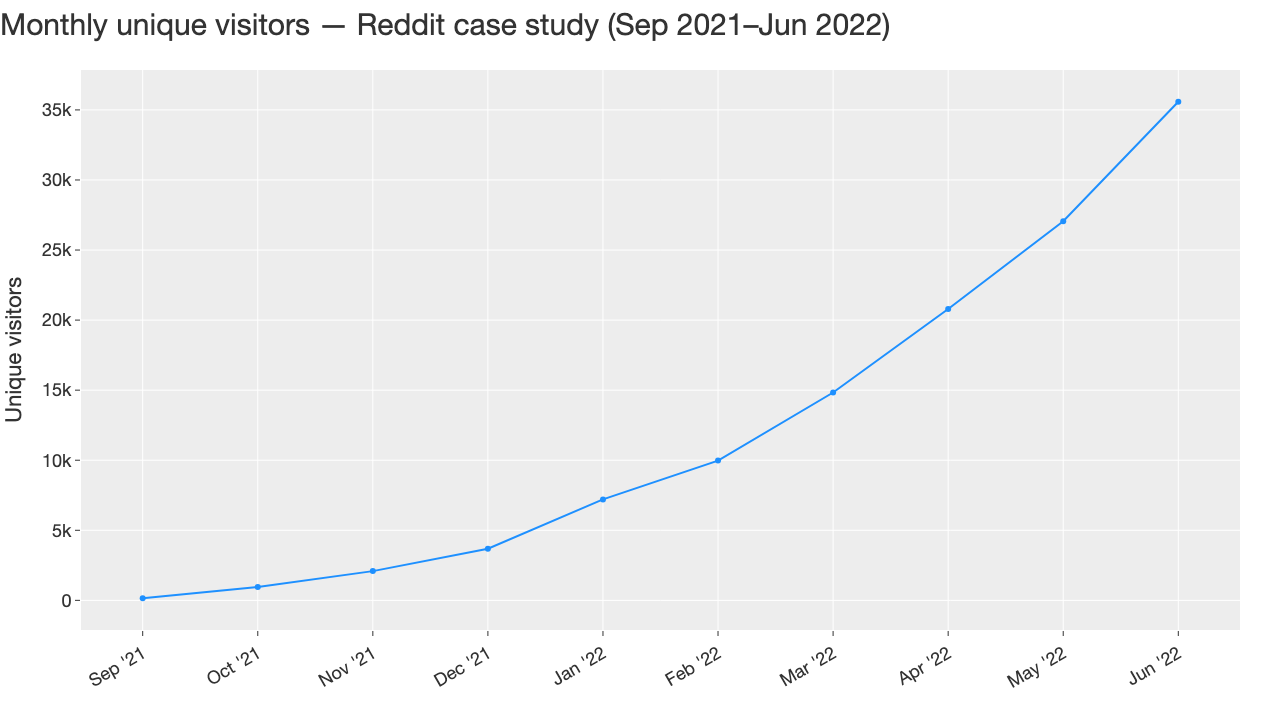
Reddit case study: expired_domain_case_study_month_4 (r/juststart), monthly metrics Sep 2021–Jun 2022
Legacy Domains Trade on Backlink Graphs, Not URLs
The marketplace for expired domains has matured into a structured industry. Platforms surface assets filtered by Domain Authority, referring domain counts, topical history, and spam scores. Buyers range from solo affiliate operators spending under $10 on a forgotten niche domain to agency teams committing five-figure budgets on properties with hundreds of quality inbound links. What they are acquiring, in every case, is the backlink graph attached to the domain and the crawl history Google has accumulated over years of indexing its pages.
The mechanics of reactivation follow a recognizable sequence. Operators run the domain through archive tools like the Wayback Machine to confirm topical continuity—a domain that ran as a legitimate gardening resource in 2011 and a payday-loan affiliate by 2016 is contaminated goods. Backlink audits using tools like Ahrefs or Majestic map the inbound link profile: which referring domains are still live, what anchor text patterns exist, whether toxic signals have accumulated. Then comes the redirect architecture—either a domain-level 301 pointing all traffic to a topically relevant receiving page, or page-level redirects that preserve the original URL structure and funnel authority into matching content.
The largest documented reactivation projects layer aggressive content strategy on top of that infrastructure. One agency-managed relaunch combined a high-authority expired domain with three additional redirected domains, staged 500,000 words of content across Cloudflare-routed category pages, issued a press release to establish legitimacy, and reported 312% organic traffic growth in six months—from near zero to over 18,000 monthly organic sessions, with 48 page-one keywords including 12 in the top three positions. These are not passive recoveries. They are deliberate construction projects that use legacy link equity as a foundation rather than a finished product.
New-Domain Campaigns Can Match the Timeline—Under the Right Conditions
A credible counterargument exists, and it belongs at the center of this analysis rather than its margins. Practitioners with disciplined link-building infrastructure argue that a new-domain campaign—targeting topically relevant editorial placements from day one, with clean anchor text ratios and a content architecture built around current keyword opportunity—can match or exceed the trajectory of a well-executed expired-domain strategy within the same twelve-month window.
Their case is not trivial. New domains carry no inherited disavowal debt, no brand-history baggage, and no mismatch between old backlink topicality and new content strategy. Google’s systems have also grown more sophisticated at identifying expired-domain manipulation patterns, including bulk redirect schemes and domain stacking—pointing multiple expired domains at a single target to simulate authority accumulation. Operators who have encountered manual actions from these tactics describe the recovery process as more costly than building from scratch would have been.
The honest answer is that both approaches are conditionally correct. The expired-domain strategy compresses timelines when the domain’s history is clean, topically relevant, and structurally intact. The new-domain approach is slower but more predictable, with failure modes that are almost entirely within the operator’s control from launch. What the expired-domain market has created is a high-variance instrument in an industry that consistently underestimates variance.
Six to Twelve Months: The Trust Window Nobody Advertises
Even a DA40 domain with hundreds of quality referring domains does not simply resume where it left off. After a 301 redirect is established, Googlebot must first discover and process the redirect—a step that alone can take days to weeks, depending on the domain’s prior crawl frequency. Re-indexation of the receiving site’s pages through inherited link signals follows, but Google’s systems apply a trust evaluation window during which even well-credentialed domains are held at suppressed rankings while the algorithm assesses whether the link profile reflects genuine editorial history or manipulated accumulation. For high-authority domains, that window stretches from six to twelve months—a timeline that surprises operators expecting the kind of rapid lift that smaller, cleaner experiments produce.
One namescores experiment illustrates both ends of that range. A domain-level 301 redirect, without any additional content investment, produced a measurable 10% lift in weekly organic traffic within four weeks and moved dozens of keywords from page two into page-one positions. The author acknowledged, however, that more granular page-level redirects to topically matched content would likely have amplified the effect—and that the early lift reflects a best-case scenario with a clean, narrow-profile domain rather than a guarantee for larger, more complex acquisitions.
The distinction between fast and slow recoveries often comes down to what practitioners call link profile archaeology. A domain with 200 referring domains sounds authoritative until a systematic audit reveals that 60% of those links come from pages that have since been deleted, moved, or deindexed. When the links themselves are dead, the equity they carried evaporates. What remains may be a far thinner profile than the raw referring-domain count suggests—and the trust window will price that thinness accurately, regardless of what acquisition platforms report.
The Vetting Failures That Turn Assets Into Liabilities
Experienced operators have developed systematic pre-acquisition checklists precisely because the failure modes are expensive and the most dangerous are also the least visible. Anchor text manipulation—inbound links using keyword-rich commercial anchors at ratios that suggest a link-buying campaign rather than organic citation—can render an otherwise attractive domain toxic. Historical spam signals, where the domain was used in a Private Blog Network and the footprint remains legible to Google’s classifiers, are equally disqualifying. So is contextual irrelevance, where the linking pages reference content entirely unrelated to what a new operator intends to publish.
One documented pre-reuse checklist flags these variables explicitly: full historical domain audit using backlink, archive, and spam signals; toxic link identification and disavowal planning; topical relevance mapping. The Wayback Machine history check is the determinative filter. As one case study notes, a domain that functioned as a medical blog in 2015 and then became a gambling affiliate in 2018 is immediately rejected. Topical drift is a proxy for the kind of ownership transitions that often involve link manipulation, and Google’s ability to identify and discount historically manipulated link profiles has grown materially across core algorithm updates since 2022.
Brand-reputation exposure adds a separate layer of operational risk. A domain previously associated with a defunct company or a consumer complaint pattern carries that history beyond Google’s index. Advertisers running programmatic campaigns on the revived domain may trigger brand-safety filters if the domain’s historical categorization remains in ad-network databases—a material concern for operators building toward display-advertising revenue whose approval depends on a clean site reputation.
Why Rankings Hold Once They Finally Arrive
The most consistently reported finding across expired-domain case studies is also the least glamorous: once rankings stabilize on a well-vetted reactivated domain, they hold more durably than comparable new-build equivalents. The mechanism is precise. A domain that has accumulated editorial citations over a decade—links embedded in content that has itself survived multiple algorithm cycles—has demonstrated a form of persistence that Google’s quality signals are specifically designed to recognize. Those links were not built to game a specific algorithm version. They exist because the content that earned them was genuinely referenced, and that genuine reference history is difficult to replicate on a compressed timeline with a new domain.
This is the legitimate value proposition underneath the shortcut narrative. The expired domain is not primarily a way to avoid building authority. It is a way to acquire authority that was earned under conditions—organic citation, long temporal accumulation, topical editorial context—that current link-building operations can rarely reproduce authentically. When the domain’s history validates those conditions, the foundation is real. When it does not, the collapse is rapid and recovery is expensive.
The determining factor, in every documented case, is the quality of due diligence performed before the acquisition budget is committed. The operators extracting genuine value from legacy domains are treating acquisition as a technical vetting problem. Those treating it as a numbers game are finding that Google’s systems have grown considerably better at telling the difference. The expired-domain market is not going away—the economic incentive to compress a multi-year authority timeline into months is too strong—but it has become a high-variance instrument that rewards precision and punishes shortcuts more reliably than it once did.