
DuckDuckGo’s privacy-first architecture strips referral data — leaving publishers unable to see where their traffic is really coming from.
DuckDuckGo Is Driving Real Traffic: Are You Ignoring It?
Every time a user clicks a DuckDuckGo result and lands on a publisher’s site, the referral data dies in transit. DuckDuckGo’s privacy architecture strips the signal before it reaches the destination, which means standard analytics platforms log that session as direct traffic — or, in some attribution models, fold it into the dark social bucket. The practical consequence is industry-wide: DuckDuckGo’s contribution to publisher revenue is almost certainly being systematically undercounted, at scale, right now, and most publishers have no idea.
Marcus Hawthorne, an independent tech blogger covering privacy software and open-source tooling, discovered the gap not by auditing his attribution stack but by accident. When he pulled his analytics dashboard in January 2026 after four years of near-zero Google organic traffic, DuckDuckGo had quietly become his single largest search referrer — delivering twice the leads of every other channel combined. “I assumed it was a fluke,” he said. “Then I checked the year before. And the year before that.” Hawthorne’s blog, which targets a technically sophisticated, privacy-conscious readership, is a single data point — not a generalizable finding. But it is arithmetically plausible for that audience, and it illustrates exactly the kind of signal that disappears when referral data is stripped at the source.
The volume argument against treating DuckDuckGo seriously is real and should not be minimized. StatCounter’s February 2026 snapshot puts the engine at 0.76% of global search-engine market share against Google’s approximately 90%. Backlinko’s compilation of DuckDuckGo’s own published figures — an aggregation of press releases and third-party data rather than independently audited figures — places it at roughly 3 billion queries per month. Those two numbers appear to pull in opposite directions, and they require a bridging sentence: StatCounter measures share across all web searches, including mobile and bot traffic, while DuckDuckGo’s self-reported query counts are desktop-weighted and draw from a narrower but more engaged user base. Both figures are accurate on their own terms. Together they describe an engine with a small global footprint and a disproportionately valuable core audience.
That audience matters more than the market-share headline suggests. DuckDuckGo’s user base skews toward the United States, leans heavily on desktop browsers, and self-selects for users who have actively rejected Google’s data practices — a cohort that independent research consistently characterizes as higher-income, more technically literate, and more deliberate in their purchase decisions than the median search user. For a publisher selling developer tooling, privacy software, cybersecurity services, or B2B SaaS subscriptions, that demographic profile can compress the volume gap considerably. Backlinko notes that daily search activity has remained relatively stable since 2021 and does not show recent signs of growth — roughly 100 million queries per day — which makes DuckDuckGo a consistent, measurable audience rather than a growth story. The SEO industry has responded accordingly: by largely ignoring it.
No major SEO platform — not Semrush, not Ahrefs, not Moz — offers a dedicated DuckDuckGo keyword research module as of 2026. None of their public product pages, changelogs, or documented feature sets include DuckDuckGo-specific volume data or ranking trackers. Practitioners who want to estimate demand on the engine are forced into a manual approximation: pull Google-indexed keyword volumes, apply StatCounter’s regional and device market-share percentages as a multiplier, and sanity-check the result against DuckDuckGo’s published query totals. It works, but it introduces compounding error at each stage and has to be reassembled by hand every time.
The more important question is why the market has declined to automate it. DuckDuckGo’s query volume has been stable at roughly 100 million daily searches for five years. That stability is not a growth story, which partly explains the vendor indifference. But it also is not irrelevance. It is a proven, durable audience that has demonstrated it will not return to Google — and the platforms built to serve publishers trying to reach search audiences have constructed almost no infrastructure around it. The reason is structural rather than conspiratorial: DuckDuckGo cannot offer the keyword suggestion APIs, volume exports, and ranking trackers that Google’s ecosystem makes available. Toolmakers cannot productize a DuckDuckGo module as easily as they can extend an existing Google-first toolset. The gap persists because the market has organized itself around the data that is easiest to access, not the audience that is most valuable per conversion.
The attribution problem sharpens this dynamic. Because referral data is stripped by design, publishers relying on standard analytics setups will never see DuckDuckGo labeled as a traffic source unless they have explicitly instrumented for it. Hawthorne noticed his numbers because he was actively investigating why Google had stopped sending him traffic. Most publishers are not looking. They are accepting the direct bucket at face value and moving on — which means the channel that already lacks dedicated tooling also lacks the first-party signal that would prompt anyone to build that tooling.
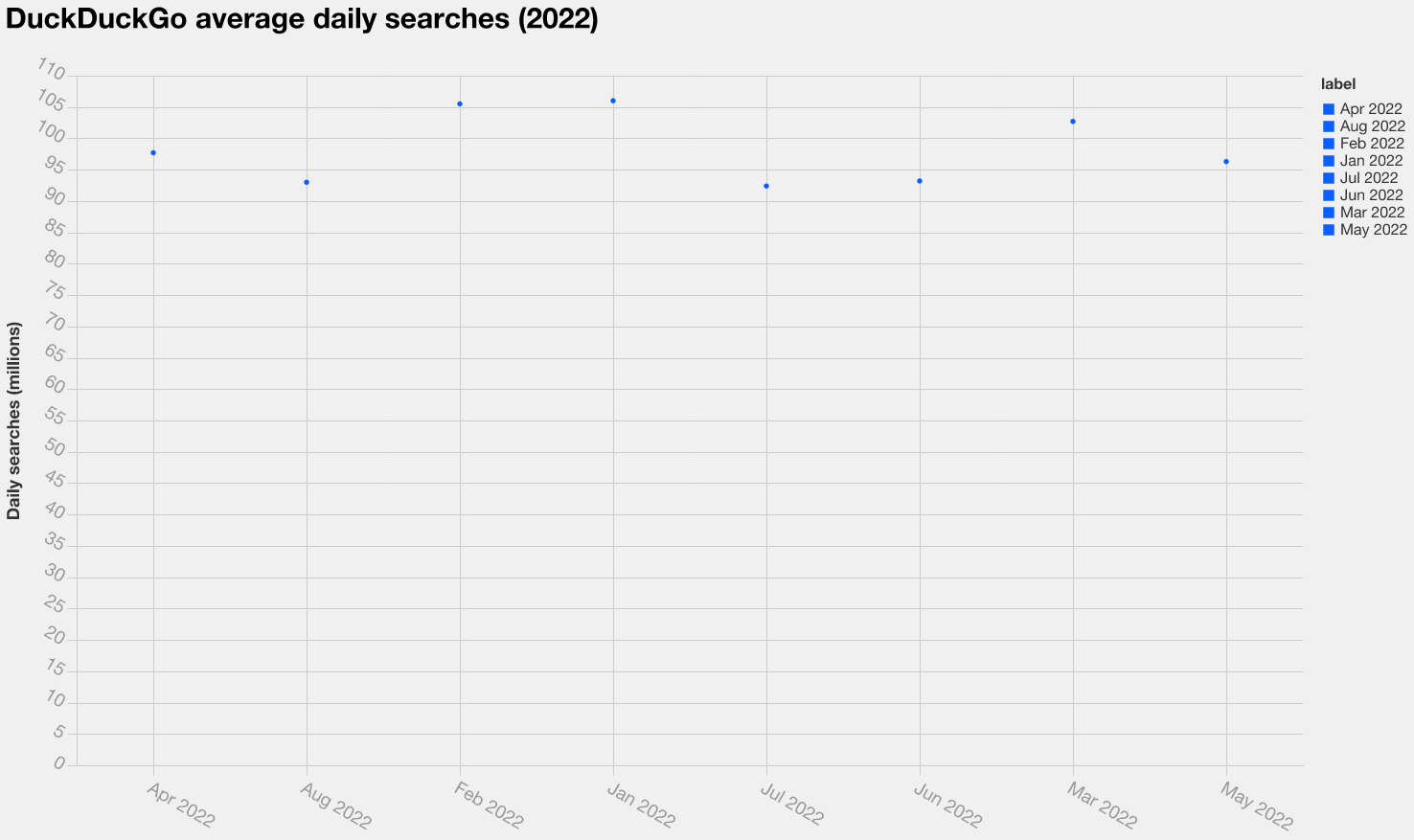
SearchEndurance monthly averages (Jan–Aug 2022); Backlinko summary of DuckDuckGo daily averages
SearchEndurance’s breakdown of DuckDuckGo’s 2022 daily average figures — ranging from 106 million in January to around 93 million by August — illustrates both the engine’s real scale and its susceptibility to seasonal and event-driven volatility. That volatility complicates forecasting for a channel publishers cannot instrument directly. It also undercuts the “set it and forget it” appeal of DuckDuckGo optimization: the engine largely uses Bing’s index and requires no separate technical crawl strategy, but without reliable performance data, publishers cannot tell whether their rankings are improving, degrading, or simply fluctuating with the news cycle.
For publishers operating in DuckDuckGo’s core demographic — developer tools, privacy technology, B2B services, cybersecurity — the practical implication is unambiguous: the channel is almost certainly delivering more revenue than your analytics report shows, and the measurement gap is a design feature of the engine, not a bug in your stack. For SEO vendors, the implication is less comfortable: a stable 100-million-query-per-day audience has existed for five years without a single major platform building dedicated tooling around it, and the most defensible explanation is that the data required to build that tooling is inaccessible by design — which is also the same reason your clients are flying blind on a channel that may be quietly outperforming their attribution model.
Hawthorne did not set out to build a DuckDuckGo strategy. He built content for a privacy-focused audience and then looked at where the search traffic was actually coming from. The lesson is less about DuckDuckGo specifically and more about the cost of trusting an analytics setup that was never designed to see this channel clearly. In a search ecosystem where referral data is stripped by design, the traffic you cannot measure is the traffic most worth investigating.