Google Search Update
Google’s August 2026 Spam Update Finished in 64 Hours. It Still Won’t Say What It Hunted.
Forum threads crowned it the fastest spam rollout in Google’s history. Google’s own records say otherwise, and the correction matters more than the record: what actually happened is that a 27-day enforcement process collapsed to under three days, three times in six months, with no named target.
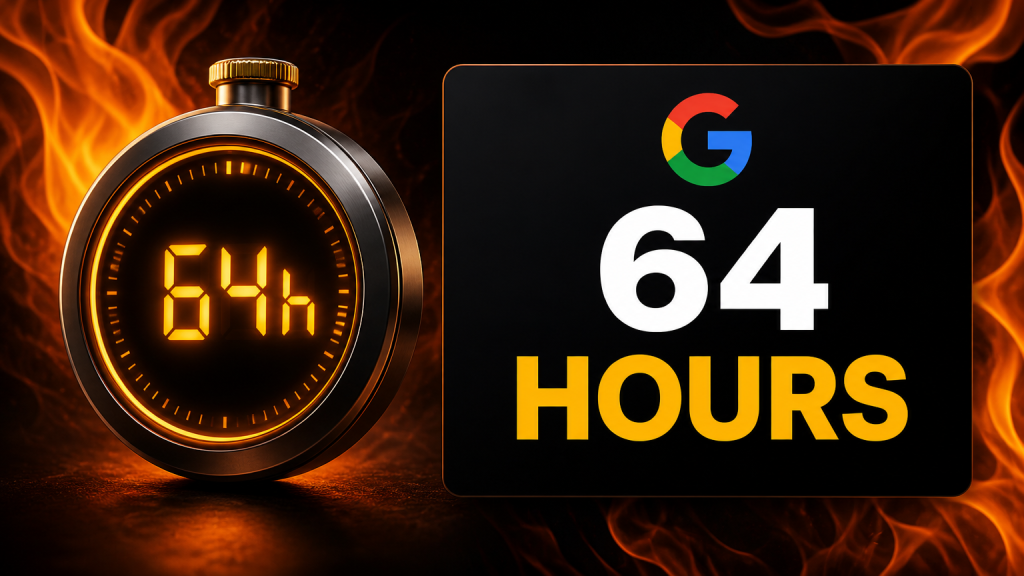
Google’s August 2026 spam update is done. It began at 9:27 a.m. Pacific on Tuesday, August 18, and Google’s Search Status Dashboard logged the rollout as complete at 1:49 a.m. Pacific this morning, August 21: 2 days, 16 hours and 22 minutes from button-push to finish. Roughly 64 hours.
That makes it the third named spam update of 2026, and the third in a row to finish in under three days. What it does not make it is the fastest, despite the thread titles circulating since this morning. More on that below, because the correction is where the real story starts.
Quick facts: August 2026 spam update
| Name | August 2026 spam update |
| Started | August 18, 2026, 9:27 a.m. PT (announcement note at 9:28 a.m.) |
| Completed | August 21, 2026, 1:49 a.m. PT (about 4:50 a.m. ET) |
| Duration | 2 days, 16 hours (per Search Engine Journal) |
| Scope | Global, all languages, classified as “Incident affecting Ranking” |
| Ruled out by Google | Link spam, site reputation abuse, “and some other policies” |
| Disclosed impact | None. Google declined to share the percentage of queries affected |
| Recovery | Review the spam policies; Google says it can take many months, with periodic refreshes |
Sources: Google Search Status Dashboard, Search Engine Roundtable, Search Engine Journal.
No, it wasn’t the fastest. That’s the point.
The March 2026 spam update holds the actual record: 19 hours and 30 minutes, the fastest confirmed rollout in the dashboard’s history, according to Search Engine Journal. The October 2022 spam update took 48 hours. The June 2026 update took 2 days and 1 hour. This week’s 2 days and 16 hours lands around fourth place overall, and third among rollouts that ran across multiple days.
Getting the record wrong matters because the “fastest ever” framing points at a one-off anomaly, and the data shows something else: a regime change. Compile every documented spam and link spam update since 2021, as Barry Schwartz’s running list does, and the pattern is a cliff.
The last time a spam update moved at the old speed was August 2025: it ran for 27 days. Everything since has finished in under three. And the cadence has tightened too: 2024 brought three spam updates, 2025 brought one, and 2026 has already matched 2024’s count with a third of the year left, June and August landing eight weeks apart.
John Mueller addressed the pace indirectly when he answered questions on LinkedIn this week. On why Google still announces these at all: “We have lots of systems that update continuously (most of them update automatically), but when we make bigger / broader changes to the systems, we try to announce them so that it’s easier for folks if they see a big jump in their metrics. That said, it’s sometimes hard to find a good balance between giving some transparency & causing unnecessary worries.” He also confirmed the update did not start before the announcement, and that the volatility people saw in the days before August 18 “was not it.”
Read those two facts together and you get a useful warning: whatever was shaking rankings between August 14 and 17 was a different, unacknowledged change. This 64-hour update sits on top of an already turbulent week, which will make attribution messy for everyone reading their Search Console data.
What Google said, and what it ducked
The total official disclosure for a global, all-languages ranking update fits in two short sentences and a LinkedIn post. Here is the complete ledger.
| Google confirmed | Detail |
|---|---|
| Confirmed | “Released the August 2026 spam update, which applies globally and to all languages.” (Dashboard, Aug 18) |
| Confirmed | “This is a normal spam update, and it will roll out for all languages and locations.” (Search Central on LinkedIn) |
| Confirmed | It does not target link spam or the site reputation abuse policy, “and some other policies.” |
| Confirmed | Recovery means reviewing the spam policies; it “can take many months,” with periodic refreshes. |
| Declined | The percentage of queries or searches impacted. Google would not tell Search Engine Roundtable when asked directly. |
| Declined | Which policies it did enforce. No blog post accompanied launch or completion; per Search Engine Journal, Google’s spam updates page hasn’t changed since December. |
The phrase “a normal spam update” is doing real work. As PPC Land noted, it is the same construction Google used for March and June, and it “functions as a limit on what Google is prepared to disclose: routine means unremarkable, and unremarkable means no further detail.” The only named system is SpamBrain, Google’s AI-based spam-prevention system, whose entire public specification is that it gets periodically improved “to make it better at spotting spam.”
Elimination leaves three suspects
Google will not name the target, but it named two things the update was not aimed at, and that lets us narrow the field. Google’s spam policies list roughly a dozen violation types. Cross off link spam and site reputation abuse, and most of what remains (cloaking, doorway abuse, comment spam, harmful content, scam and fraud) has been steadily enforced for years. Three stand out as plausible themes for a named update:
| Suspect | Why it fits |
|---|---|
| Scaled content abuse | The policy applies to mass-produced pages “no matter how it’s created,” which puts AI-generated content farms squarely in scope. It is the most actively growing spam category. |
| Expired domain abuse | Buying aged domains to inherit ranking signals has been a thriving grey market since 2024, and Google has named it as a policy but never given it a dedicated headline crackdown. |
| Manipulation of generative AI responses | The newest policy in the book, added May 15, 2026, covering attempts to manipulate AI Overviews and AI Mode. The June spam update landed a month after the policy appeared. |
The third suspect has the freshest paper trail. On May 15, Google’s spam policies page was updated so that spam now explicitly includes “attempting to manipulate generative AI responses in Google Search.” The same day, at Search Central Live Sydney, Google’s Gary Illyes and Cherry Sireetorn Prommawin compared buying or manipulating brand mentions to get cited in AI answers to paid links: detected, disregarded, ignored. Google’s own AI optimization guidance warns against “seeking inauthentic mentions,” noting its generative AI features “depend on” both core ranking systems and spam systems.
To be precise about what is confirmed: Search Engine Journal reports that as of publication, Google has not said whether the August update targeted AI-answer manipulation. The June update’s proximity to the policy change is circumstantial. But if your agency sells “GEO mention building,” the penalty risk is now documented in policy text, not rumor.
The damage report, as told by the hit
With no impact figure from Google, the evidence is anecdotal, and it cuts both ways. In Search Engine Roundtable’s comments and WebmasterWorld:
OK, this Anti-Anti Spam Update is not looking so good. All the niche sites that are strongly focused have been replaced by big resellers (Germany: obi, Bauhaus, Expert). These are sites that are not known for our niche. They do not have additional information other than the manufacturer description.WebmasterWorld member, quoted by Search Engine Roundtable
Traffic has been absolutely decimated. Real-time analytics show fewer than 100 visitors over a 30-minute period. Discover and Google News are dead.Site owner, Search Engine Roundtable comments
Others report that Google News and Discover indexing appears “severely delayed,” with Googlebot taking hours instead of minutes to reach fresh news stories. On r/SEO, a recipes and household-tips publisher said Discover traffic fell from 70,000 to 100,000 pageviews a day to 5,000 to 8,000 after August 18, with no technical or content changes made.
And then there are the winners. One site owner tracked a “dramatic comeback” starting August 18 and credited the update with fixing a false positive; a Black Hat World thread opened with “So far this seems to have been favorable for us.” Collateral damage and collateral benefit, same rollout. That is what a target list would have clarified, and there is no target list.
If you were hit: the first moves
The rollout closing changes what you can do with data. Per Search Engine Journal, Search Console data from August 21 onward is a cleaner read than anything pulled mid-rollout, and the weeks before August 18 are your baseline. With that in mind:
- Attribute before you act. Did the drop start August 18 to 21, or earlier? If earlier, the cause is the unacknowledged turbulence Mueller said was not this update, and the recovery logic differs.
- Touch nothing for 7 to 10 days unless Search Console shows a manual action or a coverage collapse. Practitioner consensus this week: early panic edits usually make it worse.
- Check the full spam policy list, including the newest entries. Scaled content, expired domain use, and AI-answer manipulation are all in scope for future refreshes even if they were not this week’s focus.
- Recovery is measured in months, not days. Google’s documentation says its systems need “a period of months” to re-learn compliance, and refreshes are when recoveries surface. Your next real checkpoint is the next refresh.
- If you buy AI mentions or citations, stop. The policy text is live and the comparison to paid links is on the record from Google’s own people.
The new cadence
The headline number everyone will recycle this week is wrong, and the right number is more interesting. Google did not run its fastest spam rollout ever; it ran its third sub-three-day rollout in six months, after a 27-day era that ended last September. Spam enforcement has shifted from an annual event to a quarterly drumbeat, shipping whenever SpamBrain improvements are ready, with the same two sentences of disclosure every time.
For sites that were hit, the practical reality is blunt: the rollout is closed, the data is now readable, and the recovery clock runs in months. For everyone else, the lesson of August 2026 is not what this update hunted. It is that the next one is probably weeks away, and Google has signaled, three times now, exactly how much detail to expect.
Sources
- Google Search Status Dashboard: August 2026 spam update incident (primary timestamps)
- Search Engine Roundtable: Google August 2026 Spam Update Is Done Rolling Out (quick facts, exclusions, community reports, historical list)
- Search Engine Roundtable: Google August 2026 Spam Update Is Rolling Out (Mueller Q&A)
- Search Engine Journal: Google Finishes Rolling Out The August 2026 Spam Update (2 days 16 hours, March record, no blog post)
- PPC Land: Google’s third spam update of 2026 hits every language and region (“normal spam update” analysis, June duration)
- Google Search Central: Spam Policies (May 15, 2026 revision adding generative AI manipulation)
- Search Engine Roundtable: Google Strongly Warns Against Manipulating Brand Mentions For AI (Illyes, paid-links comparison)
- r/SEO: Discover lost in almost 2 days and r/SEO: rollout completion thread