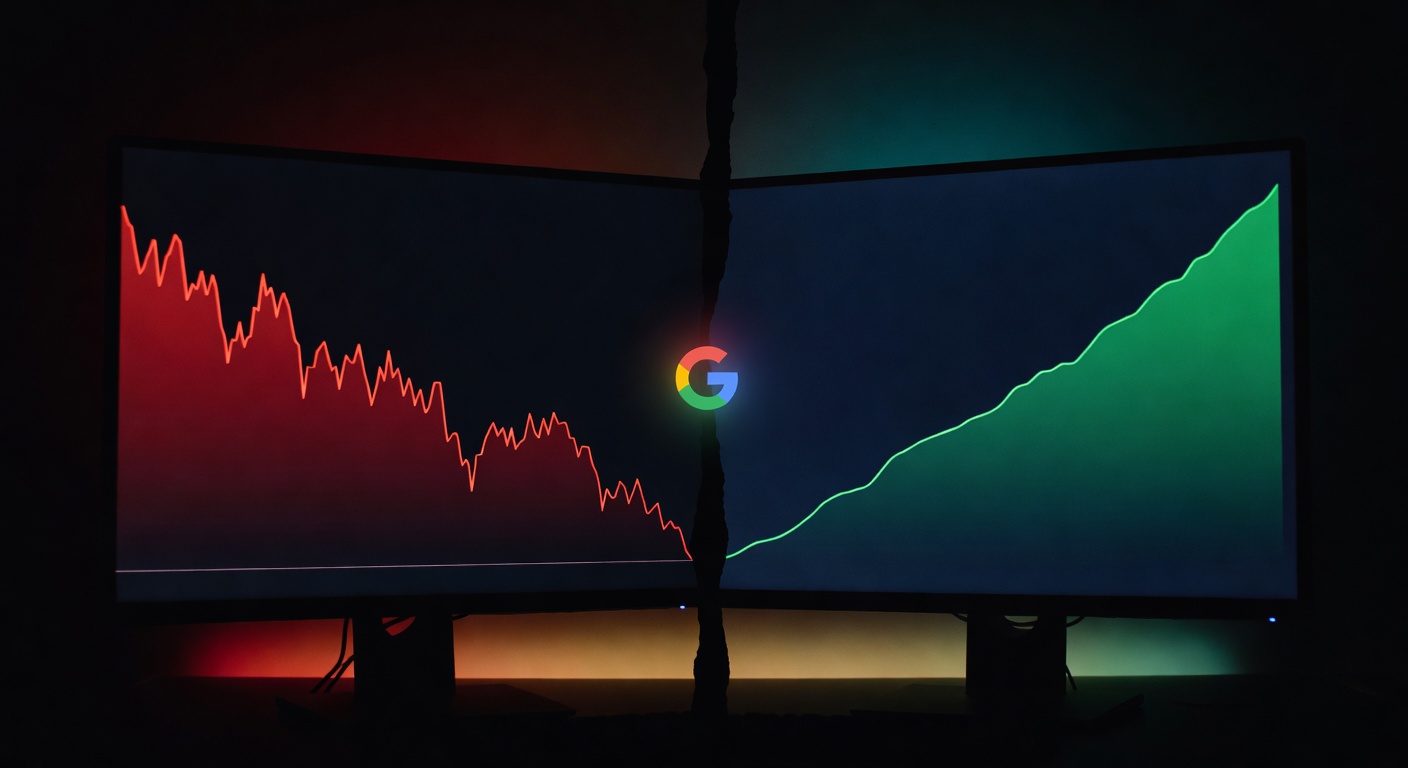
Rank-tracking tools recorded volatility 3.2x higher than the December 2025 update during the March 2026 core rollout.
Google’s March 2026 Core Update: Winners, Losers, and Patterns
The first sign something had shifted came not from Google, but from Reddit. Starting around March 16, threads in r/SEO and r/bigseo began filling with reports of sudden, unexplained traffic drops — site owners watching their Google Search Console dashboards register losses that, in some cases, looked like a server going offline. By the time Google’s Search Liaison Danny Sullivan confirmed the update on X, the damage had already been done to a significant portion of the web’s automated content operations.
What followed was the most turbulent two-week window in search rankings since the November 2024 core update. Semrush Sensor peaked at 9.4 out of 10 during days three through five of the rollout — a volatility reading that tool operators described as exceptional. AccuRanker and SISTRIX registered comparable spikes. The underlying data, once analysts began pulling it together, pointed toward a single unmistakable pattern: sites built on high-velocity, AI-generated content were absorbing losses at a scale the industry had not seen applied in a single update before.
The rollout began February 24 and completed over a 14-to-19-day window, making it among the longest core update deployments in recent memory. The update was Google’s third major core change of 2026, arriving unusually fast on the heels of the company’s first-ever Discover-only core update, which finished rolling out in February. Two significant algorithm changes within a month is unusual even by Google’s escalating standards, and the compressed timing caught a large segment of site owners with no adjustment window between cycles. More than 55% of sites monitored by major tracking tools recorded ranking changes in the first two weeks. Affiliate content farms and automated publishing operations reported traffic declines of 40 to 70 percent. Sullivan confirmed via X that the update explicitly targeted low-quality, automatically generated content and scaled spam — framing that matched, with uncommon precision, what the volatility data was already showing on the ground.
The mechanism appears to be embedded at the core ranking layer, not applied as a surface-level spam filter. Reporting on the update’s architecture suggests Google incorporated AI-content detection tooling built on Gemini-successor models, targeting scaled, unedited output and high content-velocity patterns rather than any single on-page heuristic. This design choice explains a pattern that confused several early analysts: individual pages on affected sites sometimes looked, in isolation, no different from pages that survived. What the system appears to have scored was the architecture of the operation — publication cadence, editorial depth, authorship signal density — rather than any one article’s word count or topic coverage. That distinction is the sharpest structural insight the volatility data offers: this was a judgment on publishing operations, not on individual documents.
The authorship signal data supports this reading. Pages carrying detailed, verifiable author credentials rose from roughly 58% to 72% of top-ranking results in the weeks following the update’s completion, according to aggregated analysis from tools tracking E-E-A-T signals across verticals. Google’s continued prioritization of Experience, Expertise, Authoritativeness, and Trustworthiness was not a new signal in isolation — but its weighted application inside this update appears materially different in magnitude from prior cycles.
The winners are easier to characterize in aggregate than in isolation. Health, legal, and financial content — verticals where E-E-A-T enforcement has historically been most visible — showed the most decisive reshuffling. Authoritative institutional publishers in those categories consolidated positions that AI-content farms had encroached on through volume-based strategies over the prior 18 months. SISTRIX’s post-update visibility data identified established editorial outlets in the health and legal verticals as consistent gainers, with some properties recording visibility index improvements of 15 to 25 percent against pre-update baselines. Websites demonstrating real-world expertise, clear authorship chains, and lower content-velocity profiles held rankings or gained ground as automated competitors lost positions. The pattern is consistent: authority of operation, not volume of output, was rewarded.
The losers are easier to name in category than by individual site. Community reports in Reddit threads and SEO forums cited specific AI-built publishing operations as casualties, naming platforms used to generate high-velocity content at scale. Those claims must be treated as unverified. They are plausible given the update’s documented targeting of content-velocity patterns, but responsible reporting requires a full triangulation — a branded versus non-branded traffic split from GSC, cross-validated against independent rank tracker data — before any site-specific conclusion can stand. The complication is real: Seroundtable confirmed Google acknowledged a serving bug during the rollout window, and analysts have not publicly confirmed whether the widely cited decline figures exclude that bug-affected period. Until that variable is controlled for, aggregate loss figures should be treated as directional rather than precise.
The March 11 branded filter, which reached full rollout to all eligible GSC properties as of March 11, 2026, adds the most useful diagnostic layer for distinguishing genuine algorithmic impact from data noise. By separating branded from non-branded query performance, site owners can isolate organic discovery traffic — where algorithm updates register most directly — from audience-recognition traffic that persists regardless of ranking changes. For high-velocity AI publishing operations specifically, the signature is distinct: non-branded impressions and clicks collapsing while branded traffic holds flat. That pattern, visible in the GSC filter without requiring additional tooling, is the clearest on-the-ground confirmation that a site absorbed the update’s core targeting rather than a transient infrastructure anomaly.
The forward picture divides into three scenarios. Sites that reduce content velocity and invest in verifiable expertise signals — author bios with corroborating professional records, primary sourcing, editorial review steps that leave fingerprints in the content itself — appear likely to stabilize within one to two ranking cycles, based on recovery patterns observed after analogous updates in 2024. Pure AI-content operations running on high publication cadence with minimal editorial intervention face compounding demotion as Google’s detection tooling improves; each subsequent update reduces the margin available for volume-based ranking strategies. The third scenario is the most structurally significant: even sites that recover or hold rankings face a click economy shifting further toward AI Overviews, meaning rank stability and traffic stability are increasingly decoupled. A position that delivered 800 clicks per month in early 2025 may deliver 400 today, as AI-generated answer panels absorb queries that previously resolved to organic clicks. The March 2026 core update is a single, visible enforcement action. The underlying shift in what a ranking is actually worth is a longer-running change that no recovery from this update alone will reverse.